Spooky Day
Saturday, for all the talk of being our "spooky" day, started out as a decidedly comfy day. Which is great. I like comfy WAY more ever since the accident, for some reason. We got up, I showered without any real struggle (thanks, roll-in showers and the Kimpton Hotel group!), grabbed coffee and headed out to brunch with Grayson.
Of course, we inadvertently picked the most popular brunch spot in downtown Portland (Mother's) primarily because it was downhill (I remain a very lazy person). So we made it there uneventfully, waited diligently for our table and caught up with Grayson. Once we got our table and our food was delivered, the following exchange happened:
ALTHEA: Dad. Dad. Dad... Dad.
ME: Yes?
ALTHEA: This is the best grilled cheese ever. You have to try it.
ME: (chewing) You're not wrong.
ALTHEA: Mom. Mom. MOM! (she was at the other end of the table)
DACIA: Uh huh?
ALTHEA: (shoves grilled cheese at Dacia) Try this.
DACIA: (Skeptically) Ok. Why?
ME: No, really, you should try it.
DACIA: (chewing) ok that's really good.
And the thing is, this wasn't some exotic grilled cheese using artisanal breads and a blend of cheeses from creamery run by buddhist monks served on an oversized plate and garnished with fresh local herbs. It was just a simple grilled cheese with orange (the Vermonter in me: "ugh") Tillamook cheddar, salted butter, and sourdough sliced bread. But it was executed perfectly.
Comfort food executed perfectly is a theme we will return to tomorrow, but for now it's time to make our way to the Skeleton Key Odditorium–a combination museum and fossilized victorian sideshow. While Dacia and I were discussing how to get there (do we drive? can we take a bus/tram? can I roll?) Grayson just commandeered my chair and pushed me the whole way up the hill. This is one of my favorite things since the accident. Friends just love pushing me in the chair. And as much as I want to a remain staunchly independent person beholden to no man, I do have to admit I love the gesture because of what it means and because I can rest my shoulders. And of course Grayson, because of who he is, did it at a level that few can match, pushing me nearly a mile across town.
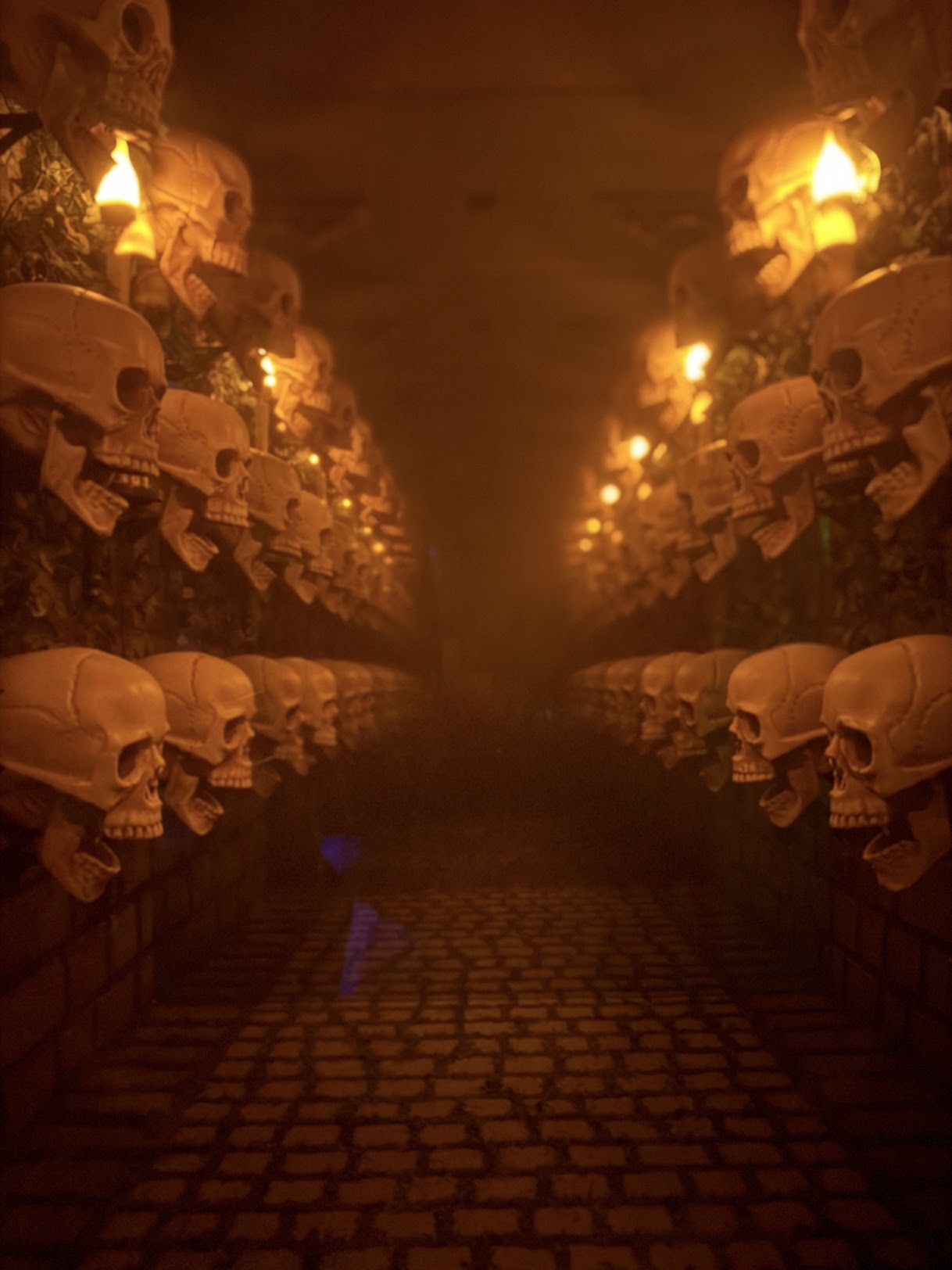
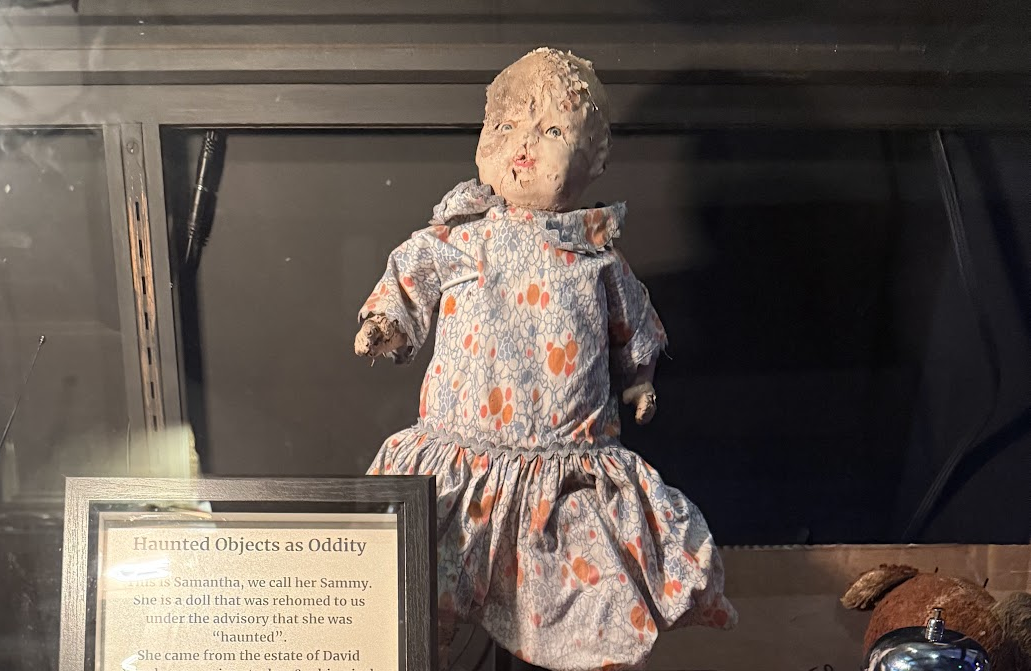
The Odditorium was way more impressive than it needed to be as an urban roadside attraction. Cleverly located in an old wood-frame building below a parking garage (so every time a car drove into the garage the whole building would shake and rumble), it was packed with a wide range of spooky ephemera from Victorian spiritualism (ouija boards and death rooms) to nordic myth to a shockingly wide range of scary clowns.
It also had the MOST ACCESSIBLE BATHROOM of the visit, at least as measured by how I use the bathroom. The room had a door that opened outward, was roughly seven by seven feet, had a wall-mounted sink and toilet (so I can get my feet underneath both) and had a generously-sized trash can within arm's reach (so I can get rid of my, ahem, bathroom aids without having to leave the room/stall). If you're wondering what I'm talking about in that last parenthetical I invite you to search for the term "neurogenic bladder" to find out more than you ever wanted to know. So why was this bathroom so good? To understand that here's a boring paragraph or two on toilet room requirements under the ADA.
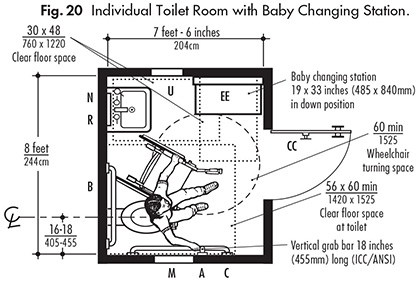
Firstly, this room didn't necessarily exceed ADA requirements–the code is relatively quiet on overall dimensions for toilet rooms, it merely dictates how much clear space is needed around the toilet (60 by 56 inches, with the toilet mounted 18 inches from the side wall), at the sink (30 by 48 inches, can incorporate the clear space under the sink) and to turn a wheelchair (a 5' circle that can also incorporate that sink space). There are a few other dimensional requirements, like the toilet seat height (17-19 inches), grab bar placement (36 inches wide behind the toilet, 54 inches wide on the side, both placed no more than 12 inches from the corner, and between 33 and 36 inches from the ground), and sink placement (too complex to explain in a parenthetical statement). All of these spatial requirements, because they represent different activities, can overlap. In practice this means that the absolute minimum size for a toilet room that complies with ADA standards is about six by seven feet.
Back when I still designed things, I wrote a number of little software tools that allowed architects and builders see, in real time, if their design was compliant with ADA code. Because we were doing this in New York, it meant, in practical terms, that we could design these rooms to be as small as possible, thus reducing the cost impact of the ADA requirements to the overall project, which in turn made our clients happy because (in most cases) this meant they would make more money. It also meant that our client's clients would have a worse experience of the building, if they needed the accommodations afforded by the code. I said yesterday that I was a bad guy, and this is what I meant.
So I think the reason this bathroom was so successful is that no architect like me ever touched it. No one was concerned with optimizing the construction to meet a capital plan that lived in a spreadsheet. No one was concerned with increasing the leasable square footage (called "efficiency" in the too-on-the-nose parlance of real estate) of the building. They simply took the available space and built a bathroom that worked. And that meant a space that had more than enough room for me to maneuver and take care of business. They probably didn't even think too much about it other than "we have a space that's about eight by eight and is plumbed for a bathroom, maybe it makes sense to make this the bathroom." This, I think, is borne out by the fact that the room is unceremoniously plonked down in the middle of the tour, right between the uranium tableware room and the exhibit on Charles Post's illness and suicide. Ultimately, it's a shame that too often, architects, contractors, and developers see the ADA code as rules to be defeated rather than guidelines to ensure equal access.
Speaking of this, let's go to dinner!
One of the ways the code interprets equality of access is that (paraphrasing here) all methods of entry, exit, and enjoyment should be equally-accessible to everyone regardless of disability. With that in mind, let's talk about the MAX train and Old Town Pizza.
The MAX train is Portland's light rail system, which extends from Hillsboro in the west to PDX in the north, Milwaukie and Clackamas in the south, and Gresham in the east. It's super extensive for a city Portland's size, and it's also super accessible. two out of the four doors on each car have a built in ramp that extends in seconds, and you can then roll on. No waiting for the driver to extend the ramp, kneel the bus, or lock you in. It costs nothing to the train's schedule and allowed me to board just like anyone else. A-plus. We rode the train from Pioneer square down through Old Portland and got off to roll the two blocks to Old Town Pizza.
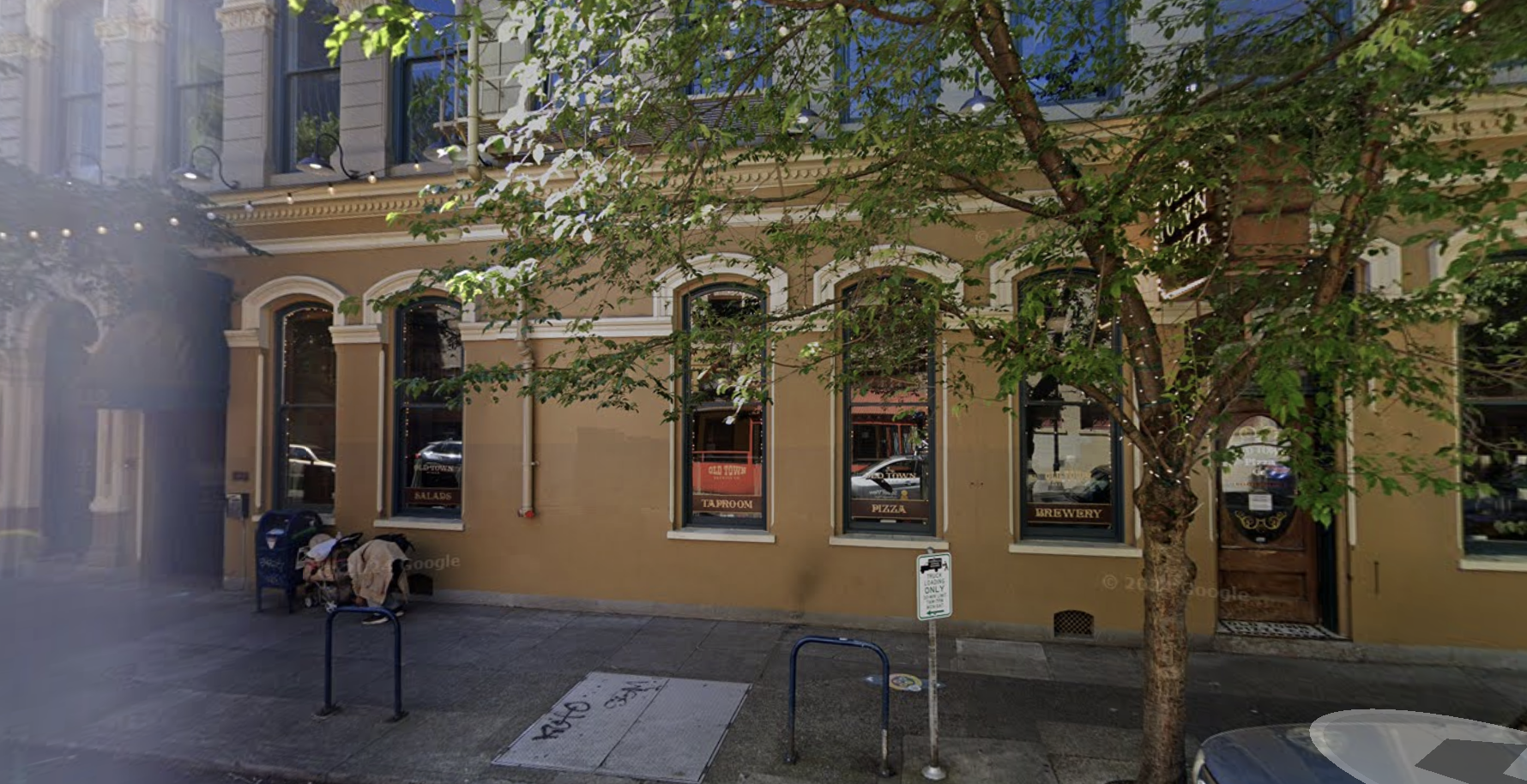
The front, and only obvious entrance to Old Town has an integrated six-inch step. So as I'm rolling up I'm thinking maybe we can't go here tonight / but the kids want pizza / maybe Dacia can help me up the stairs / will I fall over in front of strangers when my thought process is interrupted by an employee on her vape break, who offers to open the back door and gate (the awning in the photo above). Which was easy enough to roll into, but certainly wasn't equitable access. I had to roll through the entire dining area to get back to the front where we could order our pizza. The whole experience had me so frustrated that I just parked at our table and didn't explore the place all evening.
Which was a shame because Old Town claims to be Portland's most haunted restaurant. Built on top of the "Shanghai tunnels" where, during Portland's early years, sailors would purportedly be captured and bound onto outgoing ships against their will. There's graffiti in the restaurant that is seemingly from that era (along with the usual graffiti you expect in a venerable Portland pub). There's even a tour offered of the tunnels, but they explicitly state that it isn't accessible so that was a non-starter. But Arthur and Dacia did explore a bit and then came back to the table to do what they do best, research spooky stuff on the internet.
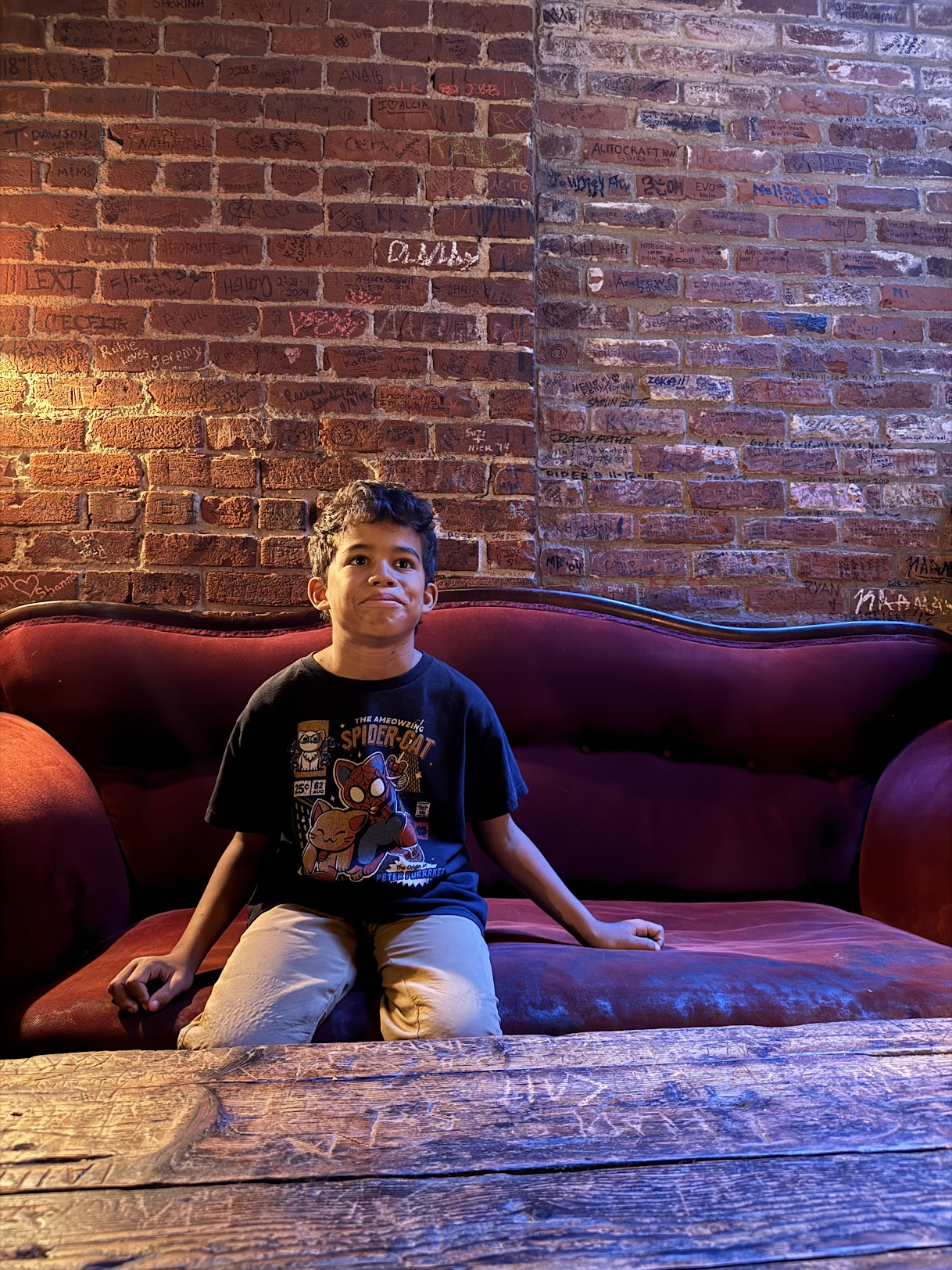
Turns out that the myths and ghost stories around both the bar and tunnels were almost certainly manufactured by zealous promoters trying to get folks to come back to their pizza place as downtown fell victim to white flight during the 1970s. The tunnels were possibly used by smugglers and other organized criminals (as they connect many of Old Portland's buildings together underground) but they were almost certainly not used in any organized way to Shanghai sailors–it was easier just to load them on the ships directly.
So our spooky day turned out to be all hat and no cattle. But that's okay because we got to spend a day together, see Grayson, enjoy some touristy stuff, and hit another vintage shop or two along the way. And we finished the night with some frozen custard at Portland's newest gothic-themed frozen custard speakeasy. Okay it's probably Portland's only gothic-themed frozen custard speakeasy, but it was a preview of what's on the menu for tomorrow:
SUGAR. LOTS OF SUGAR. Okay maybe not all that much but it certainly felt like it to me.